

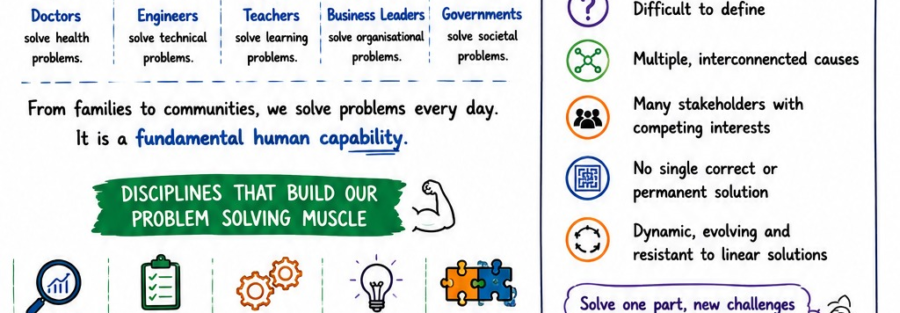
The Sustainable Development Goals are not independent goals. They are an interconnected system of Wicked Problems. Progress in one area influences many others.
Wicked Problem Solving (WPS) therefore seeks to identify the root causes, understand the interdependencies and design integrated interventions that deliver sustainable, long term results.
SDG 1: No Poverty
Wicked Problem Analysis
Poverty is not simply a lack of income. It is often the result of poor education, unemployment, weak institutions, insecurity, limited access to finance, poor infrastructure, corruption and low productivity. Giving financial aid alone does not eliminate poverty because the underlying system remains unchanged.
WPS Recommendations
- Shift from poverty alleviation to wealth creation.
- Invest heavily in skills development and entrepreneurship.
- Expand access to affordable finance for MSMEs.
- Strengthen governance and reduce corruption.
- Develop rural infrastructure and digital inclusion.
- Use data driven social protection targeted at the most vulnerable.
SDG 2: Zero Hunger
Wicked Problem Analysis
Food insecurity is influenced by climate change, insecurity, poor transportation, post harvest losses, inadequate storage, weak agricultural policies, limited mechanization and poor access to markets.
WPS Recommendations
- Modernize agriculture through technology and mechanization.
- Improve irrigation and climate resilient farming.
- Strengthen agricultural value chains and food processing.
- Invest in storage, logistics and rural roads.
- Improve security within farming communities.
- Encourage private sector investment in agriculture.
SDG 3: Good Health and Well-being
Wicked Problem Analysis
Poor health outcomes are driven by inadequate healthcare infrastructure, poverty, poor sanitation, poor nutrition, lack of health insurance, shortage of skilled personnel and weak healthcare governance.
WPS Recommendations
- Strengthen primary healthcare nationwide.
- Expand universal health insurance.
- Invest in preventive healthcare and public awareness.
- Digitize healthcare records and services.
- Improve maternal and child healthcare.
- Encourage local pharmaceutical manufacturing.
SDG 4: Quality Education
Wicked Problem Analysis
Education challenges extend beyond schools. Teacher quality, curriculum relevance, digital access, funding, poverty and graduate unemployability all contribute to poor educational outcomes.
WPS Recommendations
- Modernize curricula to include digital, entrepreneurial and problem solving skills.
- Improve teacher training and welfare.
- Expand digital learning infrastructure.
- Strengthen Technical and Vocational Education and Training.
- Increase collaboration between academia and industry.
- Measure educational outcomes rather than enrolment alone.
SDG 5: Gender Equality
Wicked Problem Analysis
Gender inequality is influenced by cultural norms, limited educational opportunities, economic exclusion, discrimination, inadequate legal protection and unequal representation in leadership.
WPS Recommendations
- Increase girls’ access to quality education.
- Promote women’s economic empowerment.
- Strengthen laws protecting women and girls.
- Increase female participation in leadership and governance.
- Support women owned businesses.
- Address cultural barriers through continuous public education.
SDG 6: Clean Water and Sanitation
Wicked Problem Analysis
Water challenges involve weak infrastructure, pollution, poor governance, inadequate maintenance, rapid urbanization and climate change. Poor sanitation further contributes to disease and reduced productivity.
WPS Recommendations
- Expand access to clean water infrastructure.
- Improve wastewater treatment and sanitation systems.
- Strengthen water resource management.
- Promote community ownership of water facilities.
- Enforce environmental protection regulations.
- Encourage private sector participation in water services.
SDG 7: Affordable and Clean Energy
Wicked Problem Analysis
Energy poverty results from inadequate investment, poor regulation, obsolete infrastructure, dependence on fossil fuels, weak transmission networks and limited renewable energy adoption.
WPS Recommendations
- Diversify energy sources through solar, wind and hydro.
- Modernize national transmission infrastructure.
- Encourage decentralized renewable energy projects.
- Improve the regulatory environment for investors.
- Support local manufacturing of renewable energy technologies.
- Promote energy efficiency across industries.
SDG 8: Decent Work and Economic Growth
Wicked Problem Analysis
High unemployment is linked to poor education, low industrialization, weak business environments, inadequate infrastructure, policy inconsistency, insecurity and limited innovation.
WPS Recommendations
- Promote industrialization and value addition.
- Improve the ease of doing business.
- Support SMEs through finance and business development services.
- Invest in digital infrastructure and innovation ecosystems.
- Align education with labour market needs.
- Create stable economic policies that encourage investment and job creation.
Concluding Thoughts
Viewed independently, each SDG appears to require separate policies and separate institutions. Wicked Problem Solving teaches us otherwise. Poverty cannot be eliminated without education. Education cannot thrive without health. Health depends on clean water. Economic growth requires reliable energy. Food security depends on climate resilience, infrastructure and peace.
The Sustainable Development Goals therefore form a single interconnected system rather than seventeen isolated objectives. Countries that adopt Wicked Problem Solving as a national capability will be better positioned to understand these relationships, coordinate policy across sectors, allocate resources more effectively and develop integrated solutions that create lasting and transformational impact.
For Nigeria and many African countries, Wicked Problem Solving is not simply another methodology. It is a strategic approach to nation building that can accelerate progress towards sustainable development while addressing the unique realities and complexities of the continent.