


Problem solving should be an essential part of our everyday lives. Every individual, whether a student, professional, entrepreneur, executive, parent or leader, should consciously develop the ability to identify problems, analyze them and create practical solutions.
Progress in life is often determined not by the number of problems we face, but by our ability to solve them effectively.
Many globally recognized disciplines have been built around developing problem solving capabilities. Business Analysis helps organizations understand business needs and recommend appropriate solutions. Project Management provides structured approaches for delivering solutions successfully. Lean Six Sigma focuses on eliminating waste, reducing variation and continuously improving processes. Design Thinking, Systems Thinking and many other bodies of knowledge also equip individuals with practical techniques for solving problems across different contexts.
The ability to solve problems is valuable in every profession and every sphere of life. Doctors solve health problems. Engineers solve technical problems. Teachers solve learning problems. Business leaders solve organizational problems. Government leaders solve societal problems. Even within our families and communities, we are constantly required to make decisions and resolve challenges. Problem solving is therefore not a specialized skill reserved for a few. It is a fundamental human capability that should be developed from childhood and strengthened throughout life.
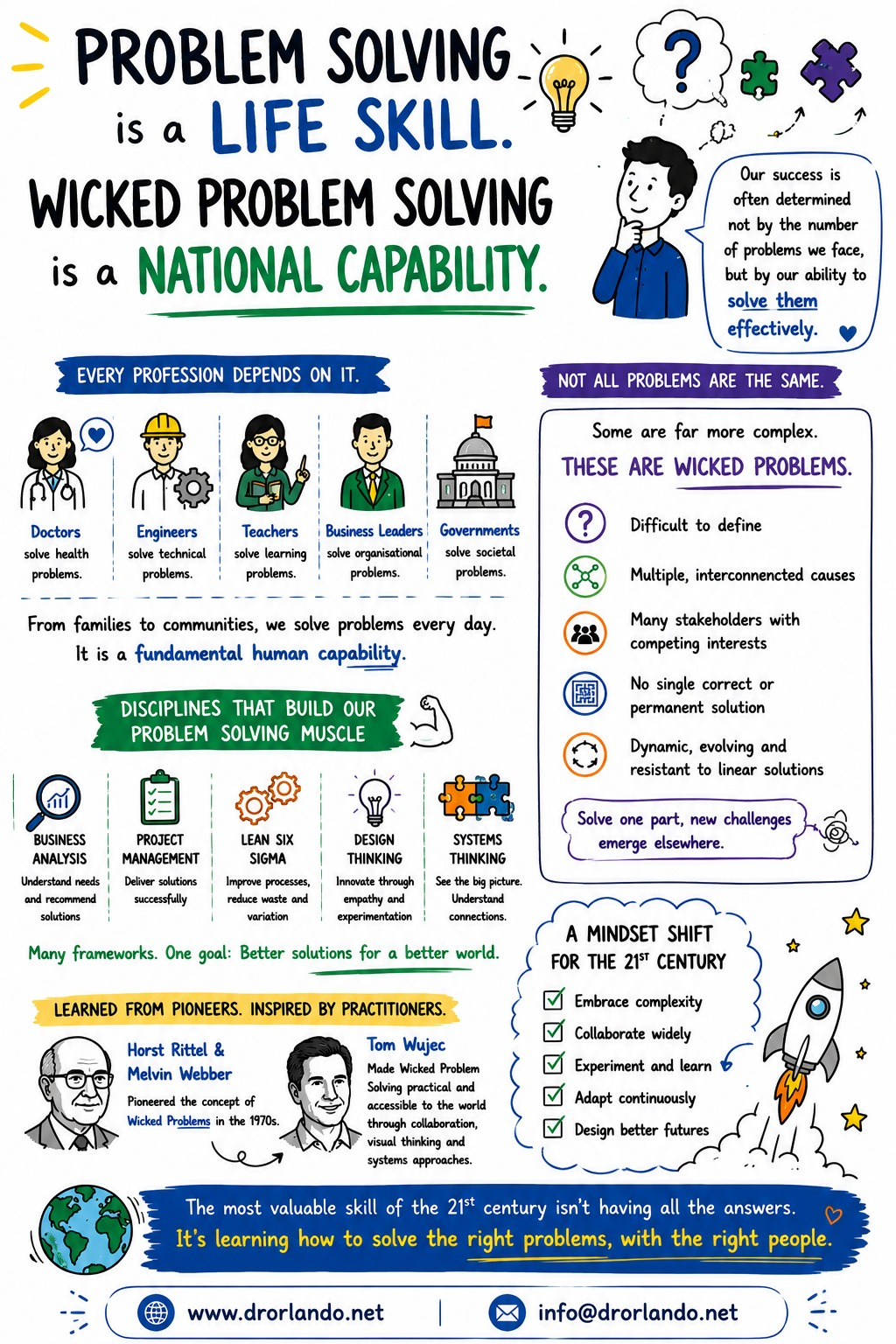
However, not all problems are the same. While many challenges have clear causes and relatively straightforward solutions, others are far more complex. These are known as Wicked Problems.
The concept of Wicked Problems was pioneered by Professor Horst Rittel in the late 1960s and later formalized by Horst Rittel and Professor Melvin M. Webber in their seminal 1973 paper, Dilemmas in a General Theory of Planning. They described Wicked Problems as problems that are difficult to define, have multiple interconnected causes, involve many stakeholders with competing interests, and have no single correct or permanent solution. Solving one aspect of the problem often creates new challenges elsewhere. These problems are dynamic, evolving and resistant to traditional linear methods of analysis and decision making.
Since then, the field has continued to evolve through the contributions of leading practitioners, researchers and educators. Among them, Tom Wujec deserves special recognition for making Wicked Problem Solving accessible to a global audience. Through his TED Talks, visual collaboration techniques, systems thinking approaches and practical facilitation methods, he has helped organizations, governments and communities understand how complex problems can be tackled through collective intelligence, experimentation and collaborative design rather than individual expertise alone.
Recognizing the growing importance of this discipline, the Project Management Institute (PMI) has also developed learning programs and professional resources on Wicked Problem Solving. PMI emphasizes that today’s project managers, business analysts and organizational leaders must go beyond managing schedules and budgets. They must be able to navigate ambiguity, engage diverse stakeholders, facilitate innovation and lead adaptive change in environments where complexity is the norm rather than the exception.
Wicked Problem Solving is particularly valuable when addressing national development challenges and the United Nations Sustainable Development Goals (SDGs). Poverty, unemployment, insecurity, weak institutions, healthcare challenges, educational inequality, environmental degradation and climate change are not isolated problems. They are deeply interconnected Wicked Problems that cannot be solved through isolated policies or single interventions.
Instead, they require systems thinking, multidisciplinary collaboration, stakeholder engagement, continuous learning and adaptive leadership. More importantly, they require solutions that are tailored to the realities of each nation rather than copied from other countries. Every country has its own political, economic, social, cultural and environmental context, and therefore requires its own unique pathway to sustainable development.
As governments around the world grapple with increasingly complex challenges, Wicked Problem Solving is emerging as one of the most important leadership capabilities of the twenty first century. It provides a practical framework for understanding complexity, encouraging innovation and developing sustainable, context driven solutions to society’s most difficult challenges.
For developing countries in particular, Wicked Problem Solving offers an opportunity to rethink public policy, accelerate progress towards the SDGs and build resilient institutions capable of delivering lasting national transformation.