

Understanding the theory of Wicked Problem Solving is only the beginning. The true value of the discipline lies in its practical application to the complex challenges facing nations.
Nigeria, like many African countries, faces numerous interconnected economic, social, environmental and governance challenges. Poverty fuels insecurity. Poor education contributes to unemployment. Weak healthcare affects productivity. Climate change impacts agriculture, which in turn affects food security and livelihoods. None of these problems exists in isolation. They influence one another, creating a web of challenges that cannot be solved through independent policies or isolated government programmes.
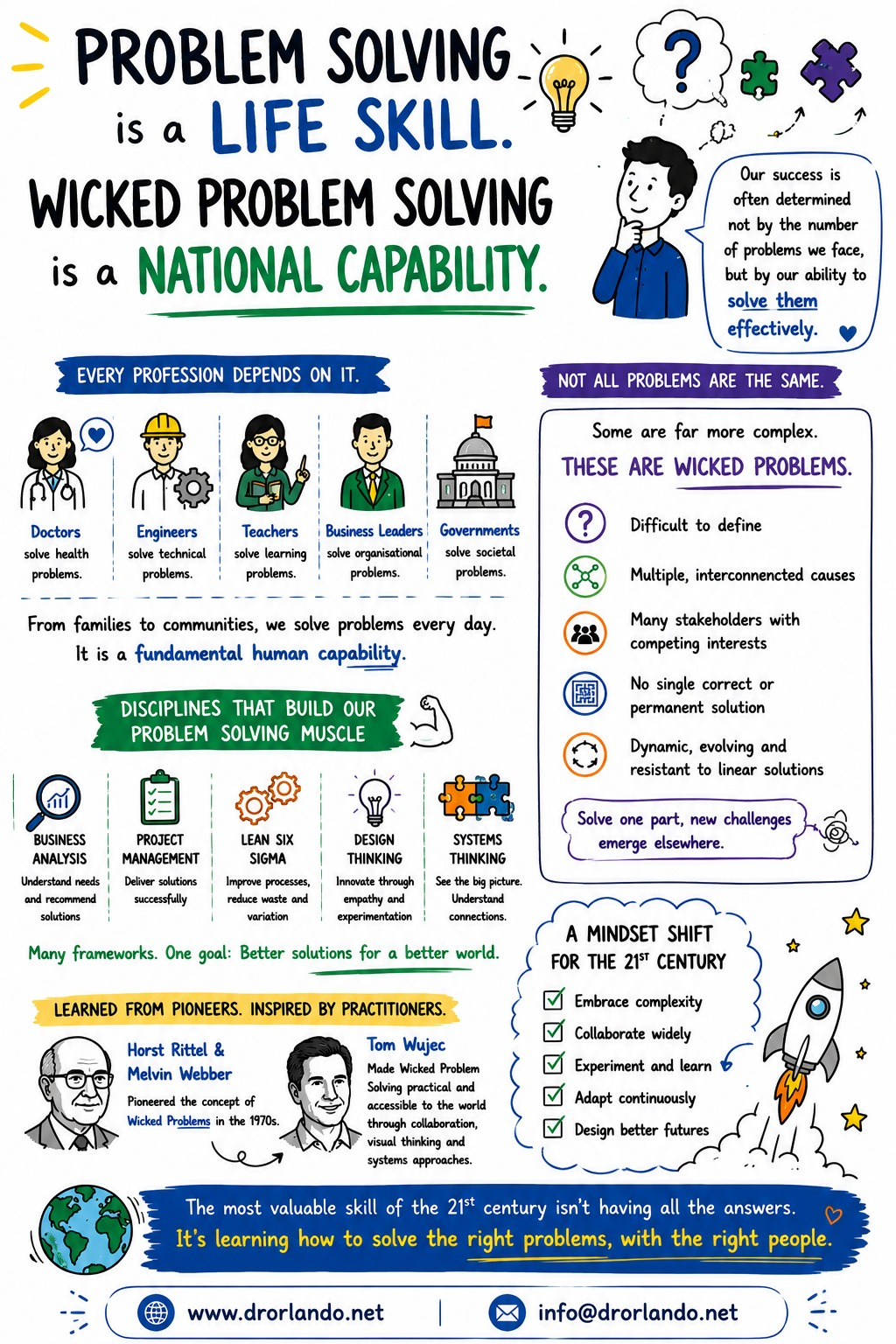
These are classic Wicked Problems.
Traditional policy making often treats each challenge as a separate issue, assigning it to a single ministry or agency with the expectation that the problem can be resolved independently. While this approach has achieved pockets of success, it has not produced the transformational outcomes required to accelerate national development. Wicked Problems require integrated thinking, cross sector collaboration and adaptive solutions that address multiple root causes simultaneously.
This is where Wicked Problem Solving (WPS) becomes a strategic national capability. Rather than asking, “How do we solve this single problem?” WPS asks, “What system of interconnected issues is creating this problem, who are the stakeholders, what are the underlying causes, and what combination of interventions can produce sustainable change?”
For Nigeria and many African countries, adopting Wicked Problem Solving as part of national planning, public policy development and programme implementation could significantly improve progress towards the United Nations Sustainable Development Goals (SDGs). It encourages governments to move beyond short term interventions and develop evidence based, context specific and collaborative solutions that reflect local realities.
In this series, we will explore how Wicked Problem Solving can be applied to each of the Sustainable Development Goals. For each SDG, we will identify the underlying Wicked Problems, examine the interconnected drivers, map the key stakeholders and recommend integrated, practical and sustainable interventions.
We begin with SDGs 1 to 8, which focus on the economic and human development foundations of every nation:
- No Poverty
- Zero Hunger
- Good Health and Well-being
- Quality Education
- Gender Equality
- Clean Water and Sanitation
- Affordable and Clean Energy
- Decent Work and Economic Growth
Rather than viewing these goals as eight separate development priorities, Wicked Problem Solving enables us to see them as one interconnected system. Progress in one goal reinforces progress in others, while failure in one area often undermines success elsewhere. Understanding these relationships is the first step towards designing solutions that are both sustainable and transformative.
The question is no longer whether Nigeria and Africa need better policies. The more important question is whether we are solving the right problems, in the right way, using the right thinking. Wicked Problem Solving provides a compelling framework for doing exactly that.